Journal of Many-sized Tales
A Sad-nice Fantasy Poem Publication
A poem for those who like their love a little sad, a little nice, and a little fantastical.
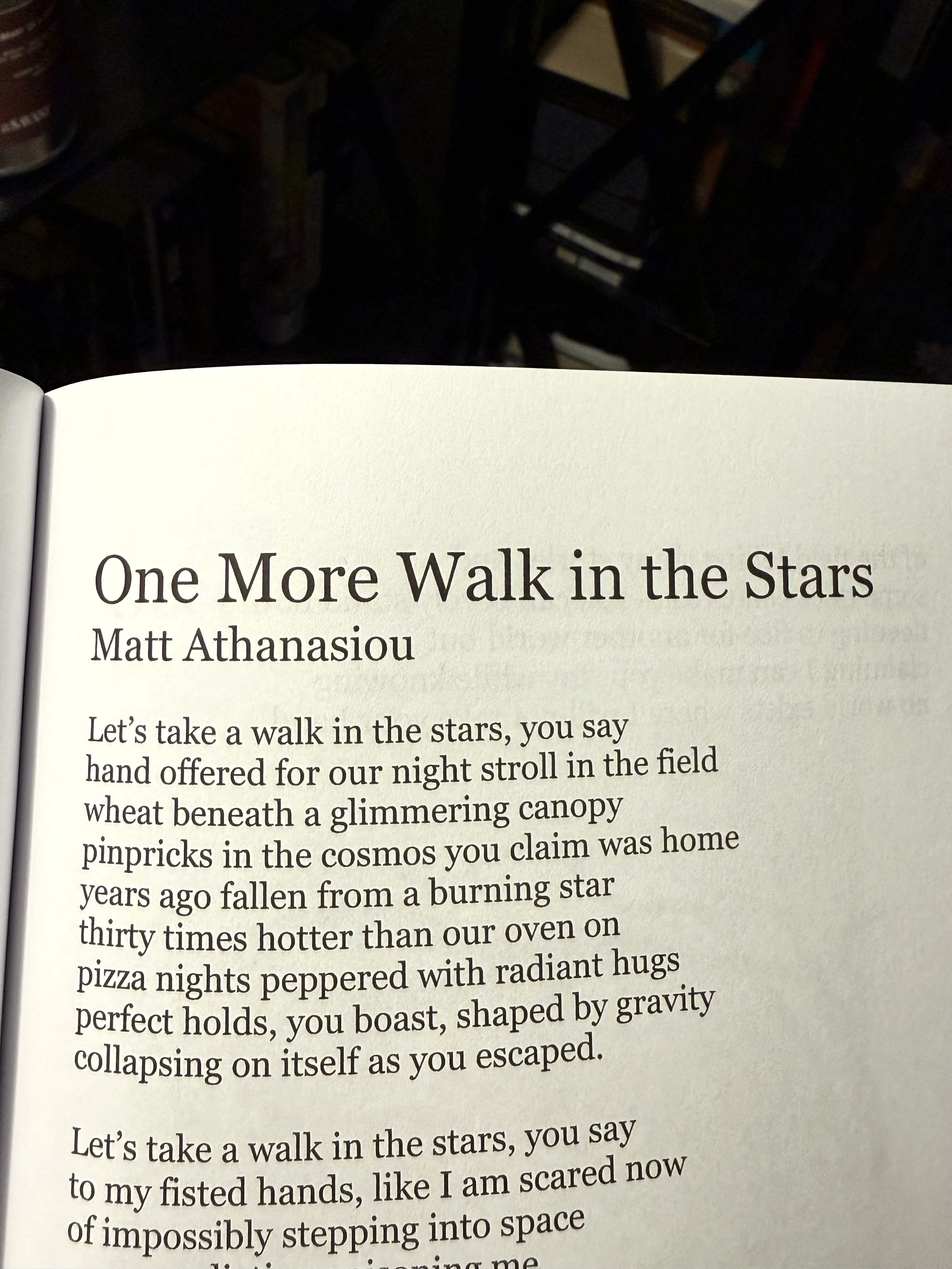
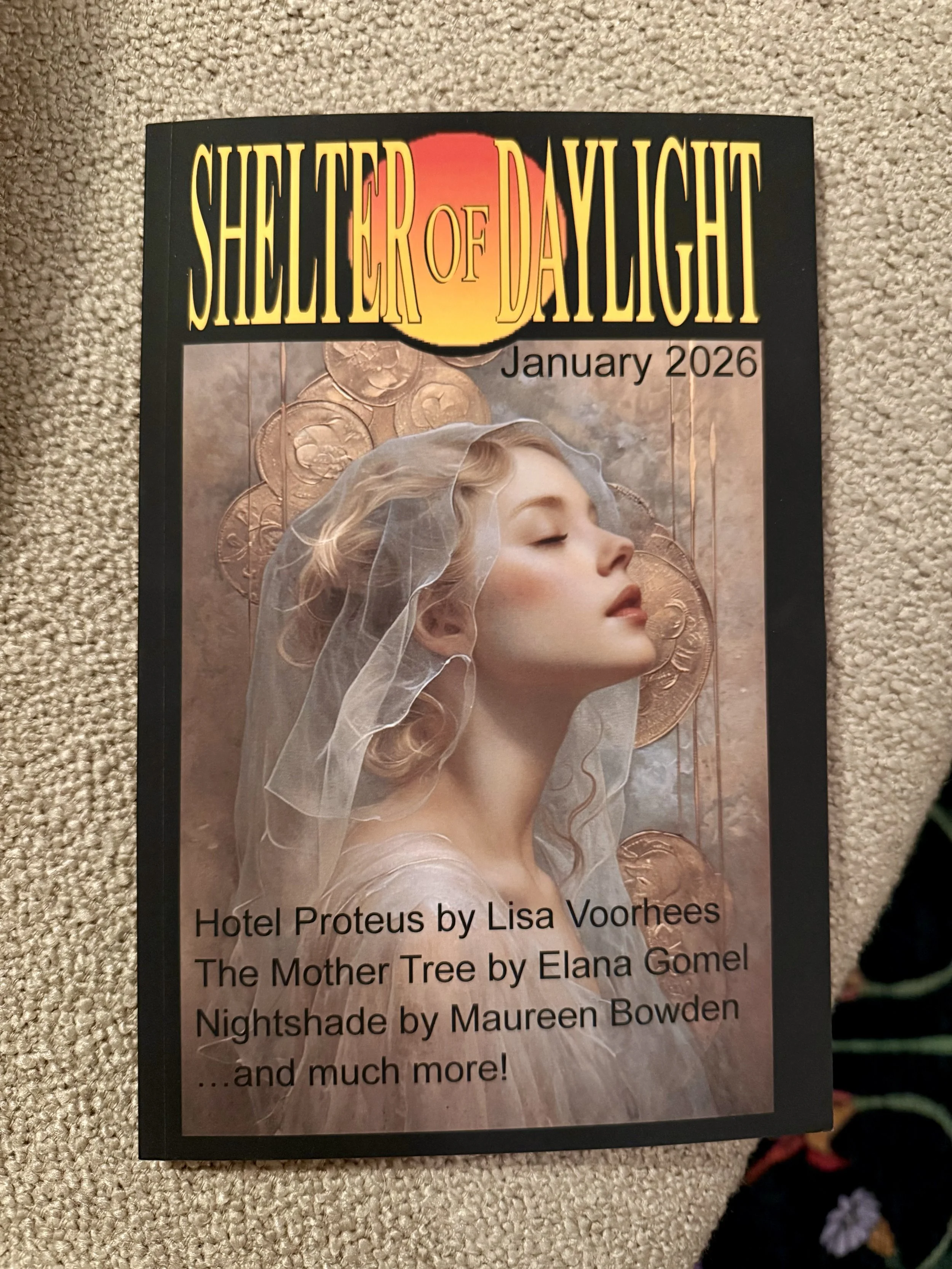
My fantasy poem, “One More Walk in the Stars,” appears in the January issue of Shelter of Daylight (from Hiraeth Publishing). Woot.
Nothing sad about this update, except for the poem itself. And it’s only a little sad. By the end, you might call it heartwarming. Just in time for Valentine’s Day.
You can check out a preview of the poem below, and if you’d like to keep reading, you can grab the issue here.
Short Story and Poetry Cover Letter Template
Reclaim writing time from sending short stories and poetry.
Sending stories and poems to publications often requires sending a cover letter. Here’s a template that has worked for me throughout the years. You may need to make updates based on individual publication guidelines, but this version requires the fewest for me.
You can copy the template or example below and save it as an email draft. Then simply replace the words between the brackets—quoted words within them are recommendations.
Subject line template
[“Short Story” / “Fiction” / “Poem” / “Poems”], [Title of Your Writing], [Last Name]
Body template
Hi [Editor Name or Publication “Editors”],
Please find my [“short story” / “story” / “flash fiction” / “poem” / “poems”], “[Title of Your Writing]” ([amount of words or lines of poetry]), [use “attached” for attaching your story versus “included” for pasting it into the email or submission manager tools].
[Your Name]’s writing has appeared in [Publication Title 1], [Publication Title 2], [Publication Title 3]. Find more of [your pronoun] at [website / primary social site].
Thank you for considering my [“story” / “poetry”].
[Your Name]
[Your phone number]
[Your email address]
Example
Fiction, The Heartbreak Hotel Gets Renovated, Dennin
Hi LuvLit Mag Editors,
Please find my short story, “The Heartbreak Hotel Gets Renovated” (1,222 words), attached for your consideration.
Sue Dennin’s writing has won the Heartache Story Award, and has appeared in publications such as Lovely Zine and Drama Digest. Find more of her work at www.suedennin.com.
Thank you for considering my story.
Sue Dennin
555-555-5555
suedennin@domain.com
Notes
When I save an email draft I tend to reuse, I typically add “TEMPLATE” to the start of the subject line, making the original easier to find and duplicate among other drafts.
The biography section should be
written in the third person—this deviates from novel queries.
dynamic. If you have several publications and awards, only list a few that fit with the magazine’s genre, ones their readers would appreciate.
skipped if you have no publications, unless the place you’re sending to asks for personal details.
brief, as the publication will ask for more information about you if they accept your piece and want extra details to share with readers.
When in doubt, write a shorter cover letter. The message bridges your story or poem to the editor. The longer you make that bridge, the more planks you need to set correctly, lest you risk the editor falling through before they can reach and fall in love with your piece.
Love for The Last House on Needless Street
Read The Last House on Needless Street.
I wrote a short review on Goodreads for Catriona Ward’s novel, The Last House on Needless Street. It’s early in the year, but there’s a good chance this is my book of the year. Similar to my favorite book in 2021, Stephen Graham Jones’s My Heart is a Chainsaw, Ward knows her characters inside and out. Read this book, and you will believe Ward got the characters to write their own parts, even convincing a cat to put down her Bible and pen her parts. Every detail serves to create an intimate and emotional portrayal of each character, making you emotionally invested in the twists and horrors that shape their lives.
I can’t recommend this novel enough, and I am very much looking forward to reading more of Ward’s work. If you want to learn more about her, this book, her other books, check out these links:
Interview on The Bestseller Experiment (a favorite writing podcast of mine).
If you give it a read, I’d love to hear your thoughts.

Sabbatical Goals that Include More Work. I Am Excited.
I’m taking a work sabbatical from mid-July through mid-October. But “work sabbatical” is a strong phrase.
I helped create a sabbatical benefit with the company I work for, and I am using the benefit mid-July through mid-October. I was the sixth hire and have been at the company almost nine years. Contributing to growing the business and devoting myself to learn as much as I could—customer experience, business development, coding, design, and so on—I put most of my mental and physical energy into the job. I love the work, the learning, the chance to collaborate with intelligent, empathetic, and creative teammates. I love the work, but I also love my personal life that I’ve neglected.
My company encourages vacation and time off—we’re a travel company, after all—but I can find it difficult to carve out time for life outside of work. No one at my job asks this of me. I love making things, and almost every day I can see how my projects help travelers and teammates. That drives me. However, my personal work, health, and relationships drive me too, and I want to invest more time in those going forward.
So I am taking a sabbatical from work to focus on personal interests and necessities. A big part of this will be concentrating on my health each day, as I have been dealing with chronic pain from various stresses for close to two years. I also plan to travel a little, heading to Scotland for a wedding, driving up to the Northwoods to see family, and potentially taking another short trip.
The other big part of the sabbatical will be for my personal projects. I will sit at my desk—or a desk or couch or log somewhere in the world—and make things most weekdays from 9–5, and I am excited. Mostly I’ll be writing, but I have a design idea or two I would like to explore. I am a week into the sabbatical, and I used that time to get a baseline for how much I can accomplish in three months. I set goals and timelines around what I learned, which I’ll share here to hold myself accountable. I’ll also post updates about progress and adjust the priorities as needed, since unexpected challenges or opportunities may pop up; I prefer not to be rigid, and mainly want to make things that I care about, and hopefully others will end up caring about them too.
Without further ado, my sabbatical goals in order of priority:
Finish L’ve novel manuscript edits and send to agents.
July 15 – September 15
Edit my picture book manuscript, Dream, Children, and send to agents.
July 15 – September 15
Research and likely launch a small lifestyle brand.
July 15 – September 15
Write the first draft of the next novel manuscript.
September 1 – September 30
Write a comic book script for the Top Cow Talent Hunt.
September 15 – October 15
Launch a newsletter for my website.
October 1 – October 15
Research and apply to writing grants for 2023.
October 1 – October 15
Write a picture manuscript for my friend to draw.
October 15 – October 30
Connect with writers on Twitter.
July 15 – weekly afterward
Continue sending stories already out in the wild.
September 1 – weekly afterward
Bonus, if time: either edit my middle grade novel manuscript or complete the Writer’s of the Future Fiction class and write a story to go with it.
Thoughtful Feedback is a Gift
No matter what you’re making, when others help you improve your work, they deserve acknowledgement.
No matter what you’re making, when others help you improve your work, they deserve acknowledgement. And that’s what this post aims to do.
Below are fellow authors who took time away from their writing to review this site. Some of their feedback has been implemented, some of it will find its way into future iterations, and all of it is much appreciated. As a small thanks, I’d love to point you toward them and their work, so you can check out what these kind and generous writers are up to.
Adam Jarvis
Robyn Sarty
Website, Facebook, and Instagram
Sadye Paez
W.J. Kite