Journal of Many-sized Tales
Here There Be Promises: Writing Goals for Q3 2023
Creative goals for Q3 2023.
Apparently, Squarespace has an AI feature that helps people write. Always curious to toy with new tech—even if I don’t intend to continue using it—of course I tried it. I asked it to sum up my goals from Q2. And according to AI, I spent a lot of time “taking online courses and attending webinars, which significantly enriched my knowledge base.” I absolutely did none of these, so my guess is the AI is summarizing another me from the multiverse, and this other me has a much vaster “knowledge base” than me. Go, other me.
#
Y’anyway, time to look at how Q2 panned out, and where I’m heading in Q3.
If you ignore some of the deadlines, I hit a number of my goals.
I journaled about writing with a CDA in mind.
I wrapped query edits with an editor.
I restarted sending the novel manuscript to agents, along with a picture book manuscript.
I wrote an unplanned sci-fi/fantasy poem and sent it to publications.
That said, I missed my big goal. I failed wrapping the third draft of my TLS novel manuscript. There are a few reasons.
The query edits took longer than I expected.
I stressed about the query and overwrote it, which took a lot of time away from working on the newest manuscript.
I began work on some of my design stretch goals, which often sent me down rabbit holes of research.
And I did not finish these stretch goals, once I noticed how much time they were eating up.
See the “unplanned sci-fi/fantasy poem” note above.
I am a little bummed about not finishing the third draft of the novel manuscript, but I understand why, and I don’t regret putting extra time into my query; the query is often your first interaction with someone you hope will fall in love with your story, and you want to ensure the write-up best represents your work and youself. I do wish I had pushed off some of the design work, but at least I better understand the scope of those projects, and I am not making them stretch goals this quarter.
#
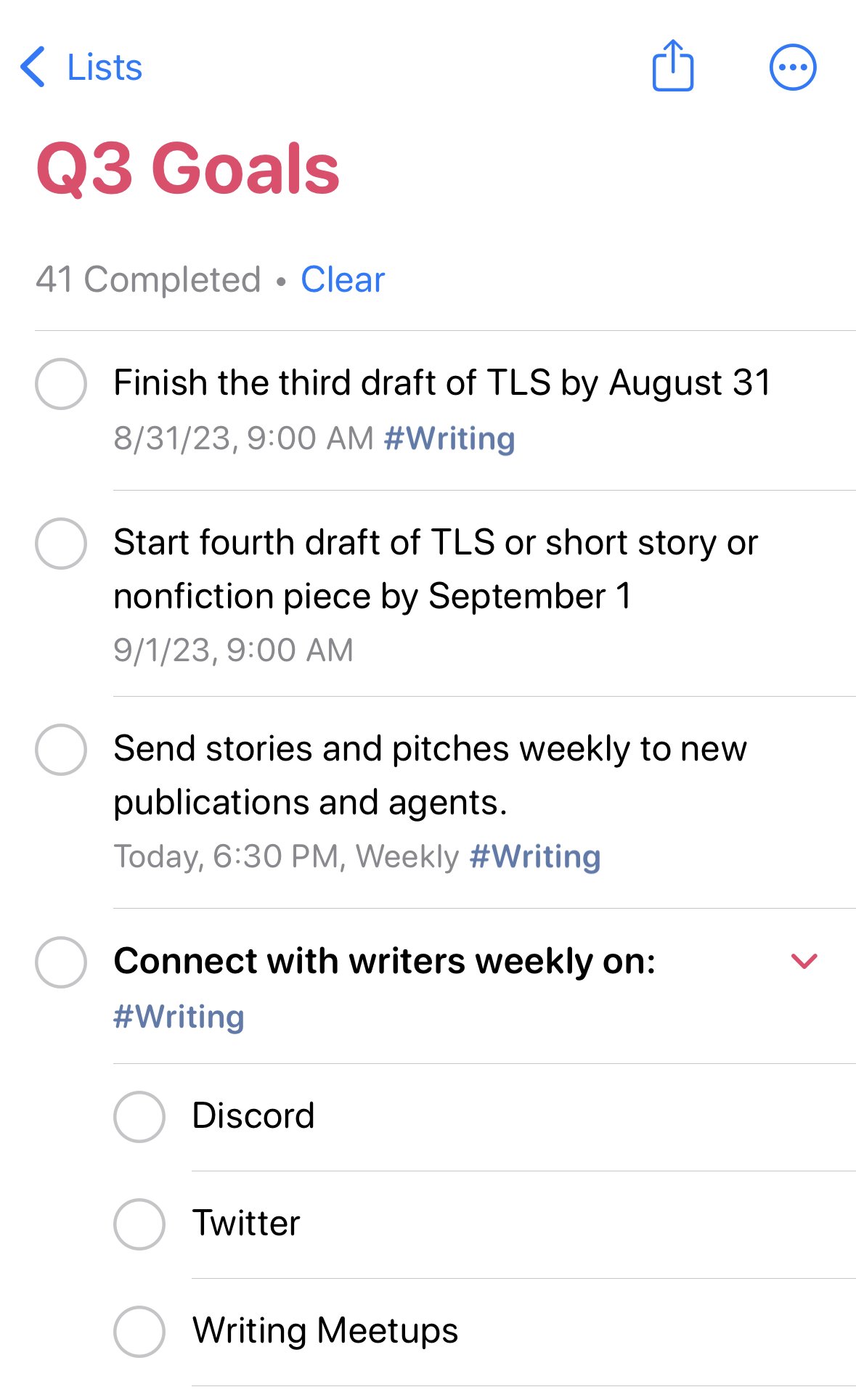
This quarter is all about wrapping the third draft and sending stories. So my goals for July, August, and September are:
Finish the third draft of TLS by August 31.
Start the fourth draft of TLS or a short story or nonfiction piece by September 1.
Send stories and pitches weekly to new publications and agents.
Connect with writers on:
Twitter / X / Whatever it’s called when you’re reading this.
Discord
Writing Meetups
And that’s that. I’m focusing on fewer things this quarter, and every focus is about writing. In theory. I’m sure I’ll get distracted by the odd design idea here and there, maybe another unplanned writing project, but as long as I enjoy them, I won’t be too upset.
For reference, again, here’s how the goals look in the iOS Reminders app, where I track them—minus some of the personal health goals, which are mostly about stretches, biking, traveling, and dealing with some chronic pain.
Feel free to let me know if and how you set goals for projects—and share them if public declarations help you hold yourself accountable.
Happy creating.
How to Tell a Story With a Central Dramatic Argument
How to tell a story.
If you read my goals for this quarter, you know this entry is a few days late, but life (and other writing projects) happen. On we go.
Some time back, my favorite writing podcast, The Bestseller Experiment, mentioned writing with a Central Dramatic Argument in mind. The concept comes from writer Craig Mazin (Chernobyl, The Last of Us, et cetera). On Scriptnotes, the podcast he hosts with John August, he dedicates an episode to discussing how the Central Dramatic Argument (referred to as CDA hereafter) works, and how story structure actually stems from CDA.
You can listen to Mazin’s thorough explanation on YouTube, and below are notes from my listen. Let’s get into it.
#
The most basic tl;dr version of writing with a CDA in mind goes like this:
Hero believes something (the opposite of the CDA). An incident occurs that makes Hero question that old belief with a new belief (the CDA). Hero fights to maintain old belief, while more incidents occur that challenge the old belief. An incident occurs that makes Hero mostly give up on old belief, but Hero cannot accept new belief. Hero feels lost. Another incident occurs that will allow Hero to reclaim old belief, but Hero leans into the newer belief through action.
The end.
Or, similarly, Hero can believe the CDA, and every obstacle Hero faces challenge that belief. The Hero fights to hold onto the CDA.
Now, for a Choose Your Own Adventure moment, if you would like additional notes on Mazin’s talk, read on; if you feel you learned enough and want some music to write to, check out the playlist I put together for my current manuscript.
#
One of the most important quotes Mazin gives is, “Structure is a symptom of a character’s relationship to a Central Dramatic Argument.” Said another way, a story’s structure is dictated by how a character views the CDA, and the structure is only there to enhance that relationship.
So what exactly is the CDA? You could also call it the theme, but it’s not just a broad word like love. It’s an argument that answers the question: What is the story about? The answer to this does not need to be earth-shattering. It can be a universal truth, but it must be an argument. Consider, instead of “love,” a story might be about, “If you love someone, set them free.” This is Mazin’s example, and it is a statement that you can argue for or against; you might also call this a thesis.
Side note: CDA typically comes after your idea, not before. You will likely get excited about an idea, and then need to figure out what it’s about, maybe even writing a full first draft to reach a final realization.
With the CDA in mind, Mazin says the purpose of the story is to take a character from ignorance (believing the opposite of your thesis, aka the antithesis) to embodying the thesis through action.
Here’s a traditional story structure that might form from writing with a CDA:
Act 1
You begin with a main character (MC) in their usual world and life. Their life exemplifies the antithesis. They are actively trying to maintain their antithetical belief and not progress their life in a new direction (toward the CDA).
An incident related to the CDA/thesis disrupts the MC’s life. This incident essentially destroys the MC’s current, static life in a meaningful way.
The MC strives to get their old life back, because the MC has real fears about losing that life—the MC has done a lot in life to avoid experiencing the fears brought on by the CDA. The audience will empathize with the fears.
Act 2
The MC reinforces their antithesis by struggling against new and worsening incidents that represent the CDA. The MC is fighting their fears, wants their old life, their “security blanket,” back. The world should seem to oppose the MC.
Something related to the CDA happens that causes the MC to doubt the antithesis. Perhaps the MC does something, or sees someone do something, that makes them experience the CDA in a good way.
Remember, your MC is rational. They can see value in other ways of life.
Midpoint: the MC questions their old beliefs, even if they do not fully understand the CDA.
Dramatic reversal: the MC leans into living the CDA, but then their fear about it comes to fruition (as a writer, Mazin says, you’re lowering the MC’s defenses and then punching them in the face). This should be one of the worst things to happen to the MC, and it should be seen as ironic that just when the MC leaned in, they are punished.
Low-point: the MC now doubts antithesis and thesis. They feel trapped and lost.
The MC’s goal to return to their old life is gone, but they fear going toward the new goal. The audience should be able to empathize with feeling lost.
Act 3
Defining moment begins: the MC has the chance to face their worst fear, the fear that made them want to stay in their old life. This moment will prove, or disprove, if the MC can embody the CDA.
Right before the defining moment happens: the MC has the option to return to their old life. This allows for temptation (if you watched The Last of Us, you can see Joel plainly experience this). If the MC can, they will reject the temptation through an extraordinary action.
Defining moment ends: the MC either succeeds or fails, but they hold onto new belief (unless you’re writing a story about failing to change).
The ending: to show a meaningful contrast, the final scene should mirror how the MC was introduced, but the MC now lives and acts based on their new belief (again, unless you want to show a failure to change).
And a last note: to create the most tension and empathy, Mazin recommends regularly asking where your MC is on their journey between the antithesis and thesis (CDA), and then doing the meanest thing you can to the MC in that moment, until the MC is left with no belief. That will make the story that much more engaging, and the ending that much more impactful.
Ever used the CDA or plan to? I’d love to hear about it on Bluesky or in the comments.
Here There Be Promises: Writing and Design Goals for Q2 2023
Some creative goals for Q2.
The first quarter has come and gone, seemingly as fast as a cobbler elf in the night. So now we’re here, early April, and it’s time to review what I completed and what’s coming next.
You can learn more about my goals process from the January post. The high level is: I enjoy setting myself goals. They hold me accountable, and I hope sharing them inspires others to create, and even share, theirs.
Below you will find my creative ambitions. I am keeping personal and health goals private for now, but I recommend weaving those into yours as well. Like Jack, all work and no play ain’t good for anyone.
#
First, a quick recap of the first quarter. I wrapped the second draft of my TLS novel manuscript, sent The Superpowers of Love query to an editor, and sort of connected with some writers via Twitter, Discord, and virtual Writing Meetups. Not too shabby.
But. I didn’t meet all of my goals. I failed to send my edited query to new agents. The edits took longer than expected, and I am okay with this. First impressions are important, and that is exactly what a query is. Plus, my original deadline was unrealistic, as I forgot to factor in the editor’s response times. Currently, I am finalizing a few sentences of the summary, and I am extending my deadline, as seen below.
Also, while I posted more about writing on Twitter, I could have done a better job of having deeper conversations on the platform, as well as on Discord and via Writing Meetups.
Lastly, I didn’t complete my stretch goal in design. I sketched and designed a few logos, but my attempts were halfhearted. Instead of forcing myself to finish and send a design I wasn’t proud of, I let go of the project. This I don’t see as a failure. Saying no can be just as important to saying yes to projects. Quitting the design contest allowed me to focus more on what I cared about. The novel manuscript and the query.
#
With that, here are my goals for April, May, and June.
Writing Goals
Write a Journal entry about Central Thematic Argument by April 14.
Send the Superpowers of Love query to agents by April 20.
Finish edits on the query by April 15
Wrap first chapter edits by April 19.
Finish the third draft of the TLS novel manuscript by June 30.
Read and take notes on the second draft of TLS by April 25.
Begin the third draft of TLS by April 26.
Send stories and queries weekly throughout Q2.
Connect with writers on:
Twitter
Discord
Writing Meetups
Design Goals
(Stretch goal) Launch a simple lifestyle brand with a store and one-page website by June 30.
(Stretch goal) Launch the site Newsletter by June 30.
Like Q1, here’s a screenshot of how I use Apple Reminders to track goals.

Drop a comment, tweet, or private message if you have questions, suggestions, or want to share your goals for accountability too.
Happy creating.
Love for The Last House on Needless Street
Read The Last House on Needless Street.
I wrote a short review on Goodreads for Catriona Ward’s novel, The Last House on Needless Street. It’s early in the year, but there’s a good chance this is my book of the year. Similar to my favorite book in 2021, Stephen Graham Jones’s My Heart is a Chainsaw, Ward knows her characters inside and out. Read this book, and you will believe Ward got the characters to write their own parts, even convincing a cat to put down her Bible and pen her parts. Every detail serves to create an intimate and emotional portrayal of each character, making you emotionally invested in the twists and horrors that shape their lives.
I can’t recommend this novel enough, and I am very much looking forward to reading more of Ward’s work. If you want to learn more about her, this book, her other books, check out these links:
Interview on The Bestseller Experiment (a favorite writing podcast of mine).
If you give it a read, I’d love to hear your thoughts.

January Echoes: Writing and Design Goals for Q1 2023
The start of goals.
I set goals most quarters, and January often sets the tone for the year.
Writing goals can feel like starting a mini-story. I’m the character, I jot down what I want to achieve, and then, like a fun first draft, I set out to see how the story unfolds.
Whether or not I achieve my aims always teaches me something. Sometimes I learn that I’m too ambitious; sometimes I learn that I’m not ambitious enough. Sometimes I learn that I care less about a desire than I thought; sometimes I learn that I care more. Either way, at the end of the quarter, I look at the results, and I use them to plan the next.
In an effort to hold myself more accountable, and to encourage others to do the same, I’m sharing my ambitions for writing and design work—I also set personal goals and health goals, but I’m keeping those private for now. Maybe learning to share more will be one of my goals in Q2.
Writing Goals
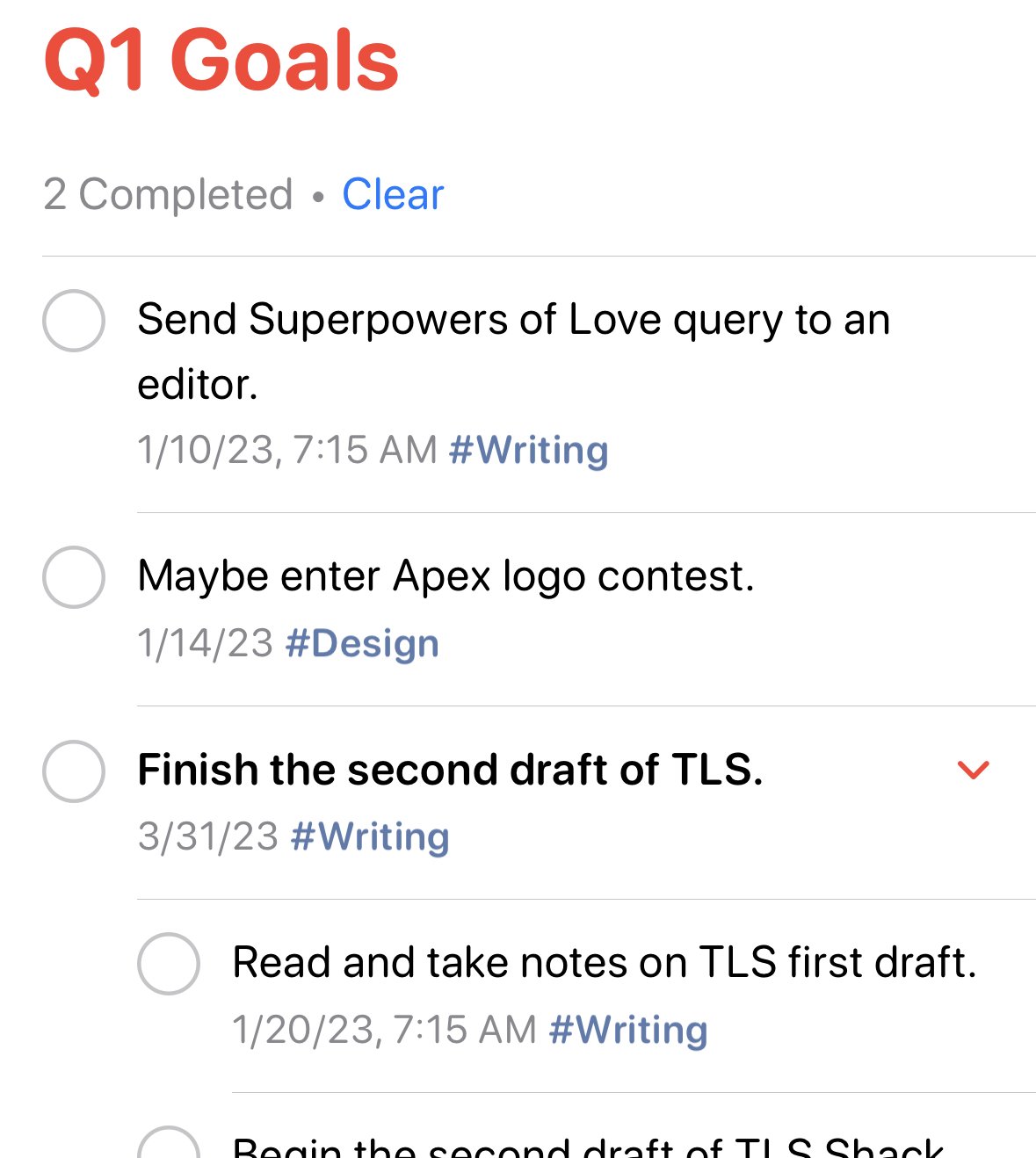
Send the Superpowers of Love query to an editor by January 10.
Finish the second draft of the TLS novel manuscript by March 31.
Read and take notes on the first draft of TLS by January 20.
Begin the second draft of TLS on January 21.
Send the Superpowers of Love query to agents by February 1.
Send stories and queries weekly throughout Q1.
Connect with writers on:
Twitter
Discord
Writing Meetups
Design Goals
(Stretch goal) Maybe enter Apex logo contest by January 14.
Here’s a screenshot of how I use Apple Reminders to track goals.
Drop a comment, tweet, or private message if you have questions, suggestions, or want to share your goals for accountability too.
Happy creating.
A Writing Interview With a Manuscript Pitch
I recently had the privilege of chatting with author Mark Stay on one of my favorite writing podcasts, The Bestseller Experiment. We briefly discuss why I joined the Bestseller Academy for a spell, how it surrounded me with a much-needed creative community, and we talk about my finished novel manuscript. He also reads a pitch for the manuscript that I’ve begun querying, which is beyond thrilling to hear. The chat happens at the end of episode 417, but I recommend giving the entire episode (and all of them) a full listen. The podcast is filled with gems of writing advice, inspiration, and welcome ridiculousness.
Writing Project Playlist: The Love Juke
Writing music but not writing music.
While doing research or writing early drafts of a new story, I often enjoy playing music that matches the tale’s atmosphere. At least, what I think the atmosphere will be, as I don’t typically outline, and my early assumptions about the story may change—except for the original idea that excited me. I write the first draft in a blur, arguably creating a messy, verbose outline, and music can help propel me along, preventing me from overthinking and over-manufacturing plot and characters.
For my next novel manuscript, I’m envisioning a tale of love, darkness, fantasy, melodrama, the Northwoods, and a lot of ridiculousness. The following is the playlist I’ve put together, so far, with those concepts in mind. The playlist is called The Love Juke, and I’m digging it.
Enjoy the ear candy.
A Note About the Time I Failed to Quit Writing
A sort of new chapter.
This entry turned out longer than expected. I had planned to write about a small piece of good writing news, but I found that the backstory was relevant, and important for me personally, to jot down. So here we go.
#
Once, before I understood query letters and the amount of effort required to edit a novel manuscript, I wrote and sent a manuscript to agents. Unsurprisingly, I received rejections and few responses. That was well over a decade ago.
Time passed. I learned more about the craft, and I wrote short stories, poems, novel manuscripts, and picture book manuscripts. A handful of short stories and poems were published, and about nine years back, an agent showed interest in one of my queries. While I was thrilled to be chatting with the agent, my life outside of writing was less than stellar. I had been making small-sized, medium-sized, and glorious-sized mistakes, as one does, and after a particularly glorious mistake that left me quite sad, I decided to quit writing. Cold turkey. I closed all of my files—almost deleted them—and I stopped sending the agent work. I believed writing was distracting me from dealing with my troubles, even causing them in some instances, and I became determined to build a stabler life of fewer mistakes.
#
Before I quit writing, I had followed the misguided idea that, if you wanted a career as an author, everything else in life—work, relationships, travels—had to be secondary, and a distant second at that. It did not matter if you found yourself living paycheck to paycheck and emptied your savings, as I mostly did; it did not matter until it did, and I wound quitting one of the things I loved most.
So, when I decided to build the aforementioned stabler life, that primarily meant finding steady work to support myself. I devoted myself to this endeavor, and having little experience in anything but making things up, I applied to nearly 100 openings. This earned me a handful of phone interviews and two in-person interviews—one of which I followed up with by mailing a Thank You postcard, except I mailed it back to myself, and the second of which I forgot my umbrella at. Perhaps because of a successful George Costanza maneuver, the latter hired me as one of two customer service agents at a travel tech startup. The entire application experience became a great reminder that, despite rejections, it only takes one yes.
#
I succeeded at not writing creatively for a year. Yay, me. However, ideas for stories and the desire to write never left, so I eventually allowed myself to restart—more like caved into restarting—but not without restrictions.
No longer would I write daily; no longer would I write for more than 30 minutes a session; and no longer would I write when friends invited me to events. I would have complete control over this creative outlet that I “once” loved, that had felt innate to me since I discovered it, and I set off, believing that I was happier when writing took a backseat to everything else. Having hindsight, I guess I enjoy spinning yarns to myself about my life, as much as I do about my characters’ lives.
Unsurprising to most reading this, my restrictions crumbled, but the breakdown was slow. Writing every few days became writing every other day became writing every day. A half hour of writing turned into an hour turned into two. Accepting most invites dwindled to accepting several dwindled to accepting some. What prolonged the collapse was my job. Focusing on building a career at the startup provided a wonderful distraction.
#
I enjoy my day job, and as mentioned earlier, I had little “professional” experience when I started. Since finding stability remained important to me, I dove into the work, treating the startup like college courses: I asked questions about everything, sat in meetings I barely understood a word of, asked to read business proposals, and worked nights and weekends to brainstorm and pitch my own ideas for the company. I heard, “No,” a lot at first, but thankfully I stuck to the notion that it only takes one person saying, “Yes.” Through all of this, I learned customer service, social media and email marketing, business development, partner relations, coding, product design, and more. My intense immersion lasted for about five years, before my body forced me to listen to my inner voice, the one telling me to write more; I say “forced,” because I developed a few physical health issues from stress, rarely allowing myself time to relax and do more of the things I loved—whereas I had once sacrificed too much for writing, I was now sacrificing too much for work.
Moving with the speed of the Tortoise, I began rebuilding my writing habit and confidence. After I had some shorter works published, I set myself the goal of writing another novel manuscript. This was in 2019, and in the blur of a month and a half, I hammered out the first draft of a story that I had been afraid to write; some of the themes frightened me, as they were too related to past mistakes, small-sized through glorious-sized. Typing, “The End,” was cathartic, and I believed I could rewrite, edit, and finish the novel within six months. Three years later, after typing, “The End,” on the final draft, talk about over promising and under delivering. What I failed to take into account were all of the bad writing lessons I had to unlearn, how many good lessons I had to learn, how much doubt from inexperience would impact me, and let’s not forget the pandemic, which really strong-armed me into focusing on my health.
All that said, while the project took longer than expected, I am overjoyed to say that not only did I wrap up the manuscript, I also queried a handful of agents last week. It feels surreal. It feels like I set out to climb a dragon-infested mountain, took numerous detours out of fear, but ultimately scaled to the top, because that is who I am. A writer. Since I first began writing, a few people in my life mentioned that I was a writer first, and whatever else I was doing second—even at my current job—and I am willing to accept that, again, albeit by also recognizing that I can be and am other things too; balance is a quality I’m constantly trying to improve. I will be packing all of the lessons I learned into my writing backpack, as I climb the mountain of my next novel manuscript, one I am excited to begin this week.
#
As to why any of this matters, why it was important for me to write a shortish retrospective, one of the newer, most important lessons in my backpack is to not fear failure. This includes not sweeping failures and mistakes under the rug. Whenever my confidence sank while writing the novel manuscript, I found myself emboldened to continue by listening to other creators discuss the struggles they overcame—many of these conversations can be found on The Bestseller Experiment podcast, which I will endlessly plug. Their stories reminded me that we are all human, sometimes orderly, sometimes messy, and for every beautiful thing we make, there are often beautiful disasters in their wake. Success is simply fewer mistakes, is simply perseverance, is simply a single yes away. I hope to add my voice to this conversation and inspire other creators, who find themselves stuck or beginning to stray.
#
Thanks to everyone who supports and supported me, directly or indirectly. I hope you enjoy the stories to come.
A Starry—Or Not So Starry—Nonfiction Article
Smashing Magazine published my nonfiction article, Rethinking Star Ratings for Readers. It has pretty pictures designed by me!
It’s been hectic, to say the least. Life in general has been. I’ll add more color to that claim later, but most of my sabbatical goals have been thrown for a loop. Disappointing, but it’s not all bad news around these parts.
The good news is that Smashing Magazine published my nonfiction article, Rethinking Star Ratings for Readers. The piece discusses some of the ways star ratings fail readers, and the write-up offers an alternative solution—with pretty pictures designed by me!—to review literature and better connect people.
The idea struck me a few years ago, and when it wouldn’t leave me alone, I finally decided to get it out of my head onto paper and pixels. I thought I would toss the finished product on this Journal and forget it, but as I wrapped up, I wondered if a publisher might be interested. And someone was. Just goes to show that you never know until you ask.
Big thanks to Smashing Magazine for sharing the piece and helping with edits, and to my friends who gave thoughtful feedback on earlier drafts.

One of the alternative solution designs that you can learn more about in the article.
Sabbatical Goals that Include More Work. I Am Excited.
I’m taking a work sabbatical from mid-July through mid-October. But “work sabbatical” is a strong phrase.
I helped create a sabbatical benefit with the company I work for, and I am using the benefit mid-July through mid-October. I was the sixth hire and have been at the company almost nine years. Contributing to growing the business and devoting myself to learn as much as I could—customer experience, business development, coding, design, and so on—I put most of my mental and physical energy into the job. I love the work, the learning, the chance to collaborate with intelligent, empathetic, and creative teammates. I love the work, but I also love my personal life that I’ve neglected.
My company encourages vacation and time off—we’re a travel company, after all—but I can find it difficult to carve out time for life outside of work. No one at my job asks this of me. I love making things, and almost every day I can see how my projects help travelers and teammates. That drives me. However, my personal work, health, and relationships drive me too, and I want to invest more time in those going forward.
So I am taking a sabbatical from work to focus on personal interests and necessities. A big part of this will be concentrating on my health each day, as I have been dealing with chronic pain from various stresses for close to two years. I also plan to travel a little, heading to Scotland for a wedding, driving up to the Northwoods to see family, and potentially taking another short trip.
The other big part of the sabbatical will be for my personal projects. I will sit at my desk—or a desk or couch or log somewhere in the world—and make things most weekdays from 9–5, and I am excited. Mostly I’ll be writing, but I have a design idea or two I would like to explore. I am a week into the sabbatical, and I used that time to get a baseline for how much I can accomplish in three months. I set goals and timelines around what I learned, which I’ll share here to hold myself accountable. I’ll also post updates about progress and adjust the priorities as needed, since unexpected challenges or opportunities may pop up; I prefer not to be rigid, and mainly want to make things that I care about, and hopefully others will end up caring about them too.
Without further ado, my sabbatical goals in order of priority:
Finish L’ve novel manuscript edits and send to agents.
July 15 – September 15
Edit my picture book manuscript, Dream, Children, and send to agents.
July 15 – September 15
Research and likely launch a small lifestyle brand.
July 15 – September 15
Write the first draft of the next novel manuscript.
September 1 – September 30
Write a comic book script for the Top Cow Talent Hunt.
September 15 – October 15
Launch a newsletter for my website.
October 1 – October 15
Research and apply to writing grants for 2023.
October 1 – October 15
Write a picture manuscript for my friend to draw.
October 15 – October 30
Connect with writers on Twitter.
July 15 – weekly afterward
Continue sending stories already out in the wild.
September 1 – weekly afterward
Bonus, if time: either edit my middle grade novel manuscript or complete the Writer’s of the Future Fiction class and write a story to go with it.